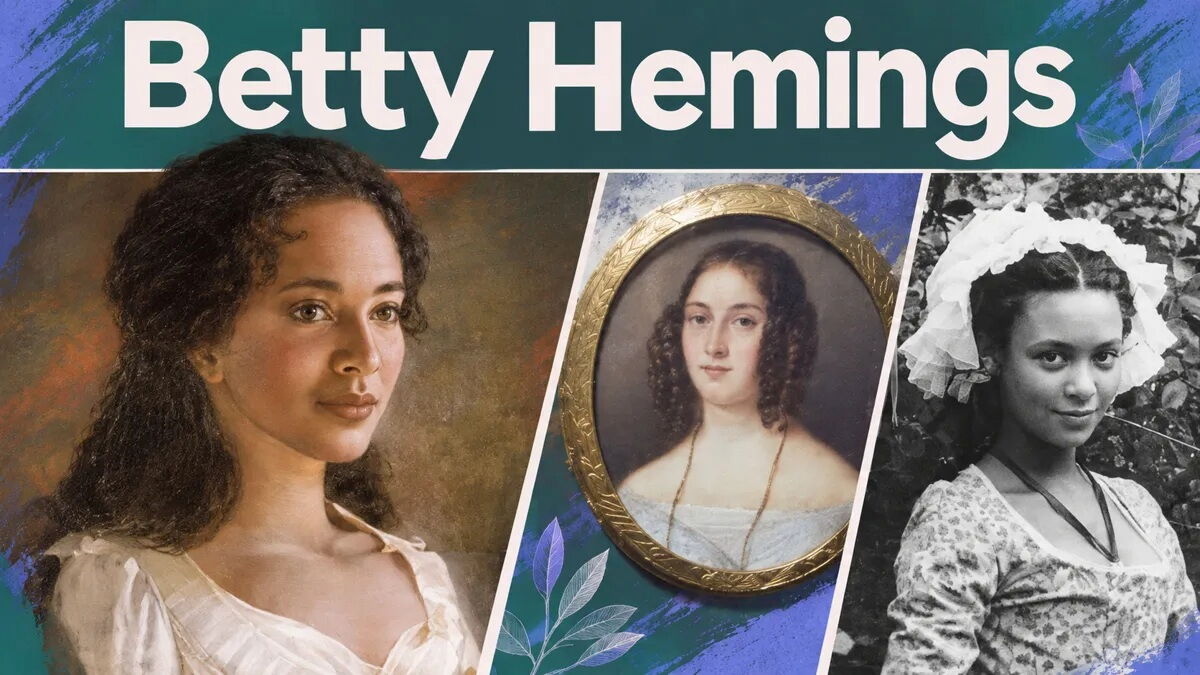
Basic Information
| Field | Details |
|---|---|
| Full name | Elizabeth “Betty” Hemings |
| Birth | c. 1735 |
| Death | 1807 (Monticello, Virginia) |
| Status | Enslaved woman; matriarch of the Hemings family at Monticello |
| Ancestry (oral tradition) | Daughter of an English sea captain and an African-born enslaved woman |
| Associated households | John Wayles (Virginia), inherited by Thomas Jefferson in 1773; moved to Monticello c. 1774 |
| Known for | Founding figure of the Hemings family whose members shaped the domestic, culinary, and craft life of Monticello |
| Notable children | Mary “Molly” (Mary Hemings Bell), Martin, Betty “Bett” Brown, Robert, James, Thenia, Critta, Peter, Sally, John |
| Notable descendants | Madison Hemings, Eston Hemings, Burwell Colbert, and many others across the 19th century |
| Historical significance | Central to understanding slavery, kinship, and power in early America; mother of Sally Hemings and siblings who were half-relatives of Martha Wayles Skelton Jefferson |
Origins and Arrival at Monticello
Betty Hemings was born around 1735 into bondage in colonial Virginia. Family memory holds that her father was an English sea captain and her mother an African-born woman, a story that resonates with the tangled roots of slavery in the Atlantic world. As a young woman, she lived in the household of John Wayles, a prominent Virginia attorney and planter.
When Wayles died in 1773, his human property was divided among his heirs. Betty and many of her children passed to his son-in-law, Thomas Jefferson. They traveled to the mountain in 1774 and formed the backbone of Monticello’s enslaved domestic corps for decades. In a place that at its peak held roughly 130 enslaved people, the Hemings family stood at the heart of the house—cooks, seamstresses, butlers, carpenters, and confidants—operating within earshot of power yet denied its protections.
The Hemings Household: Skill, Authority, and Daily Life
Within the confines of enslavement, Betty Hemings wielded matriarchal authority. Her children became some of the most skilled and visible workers at Monticello. They learned trades that required trust, precision, and a steady hand: French-inspired cookery, joinery and fine carpentry, brewing and baking, sewing and spinning, and the poised routines of butlering and chamber service.
James Hemings, trained in Paris in the mid-1780s, returned an accomplished chef and negotiated his legal manumission in 1796 after teaching his brother Peter the art and order of the kitchen. John Hemings became a master joiner whose craftsmanship still defines the visual language of Monticello’s interiors—casework, trim, furniture that balanced utility with grace. Others, like Martin, served as butler and house servant, mediating the threshold between enslaved labor and the master’s parlor.
Betty’s influence reached beyond work assignments. She nurtured kinship networks, secured opportunities within the narrow bandwidth available, and passed down knowledge that outlived bondage—recipes and techniques, yes, but also strategies for survival and small dignities under surveillance.
Children of Elizabeth “Betty” Hemings
| Name | c. Birth–Death | Role(s) and Notes |
|---|---|---|
| Mary “Molly” Hemings (later Mary Hemings Bell) | 1753–after 1834 | Eldest daughter; domestic worker; later lived as a free woman under the surname Bell and secured freedom for some of her children. |
| Martin Hemings | c. 1755–c. 1790s | Butler/house servant; prominently placed in Monticello’s domestic operations. |
| Betty “Bett” Brown (Hemings) | c. 1759–? | Domestic worker; part of the close-in household staff. |
| Robert Hemings | 1762–1819 | Coachman and domestic; purchased and gained freedom in the 1790s. |
| James Hemings | 1765–1801 | Trained in Paris; Jefferson’s chef; legally manumitted in 1796. |
| Thenia (Theanor) Hemings | c. 1767–c. 1795 | Domestic worker; part of the Hemings women’s domestic network. |
| Critta (Critta) Hemings | c. 1769–1850 | Domestic worker; mother of Burwell Colbert, who later became Jefferson’s butler and valet. |
| Peter Hemings | 1770–1834 | Brewer, baker, and cook; took over kitchen duties after James; skilled in multiple crafts. |
| Sally Hemings | 1773–1835 | Chambermaid in Jefferson’s household; mother of six children, four of whom—Beverly, Harriet, Madison, Eston—survived to adulthood. |
| John Hemings | 1776–1833 | Master joiner and carpenter; renowned for fine woodwork at Monticello and nearby projects; later manumitted. |
Note: Modern scholarship holds that six of these children—Robert, James, Thenia, Critta, Peter, and Sally—were fathered by John Wayles, making Sally Hemings and Martha Wayles Skelton Jefferson (Thomas Jefferson’s wife) half-sisters.
Paternity, Power, and Memory
The Hemings narrative combines family and power in the early republic. John Wayles’s paternity of Betty’s children tied the Hemingses to the Wayles-Jefferson family in a tangled web of kinship and pressure. After decades, scientific testing and documentary evidence convinced most historians that Thomas Jefferson fathered Sally Hemings’s children. This finding is supported by family evidence and Monticello’s proximity-based living. The depiction of intimacy under dominance—an American paradox—is inscribed into a large house’s private areas.
Legacy and Descendants
From the Revolution to Reconstruction, Betty’s descendants faced change. Madison Hemings, one of Sally’s sons, wrote about Monticello and the family’s relationship to Jefferson. Eston Hemings then took the surname Jefferson and migrated west, where some of his descendants “passed” in a racially stratified society. Master craftsman John Hemings and valet Burwell Colbert were known for their competence and reliability. These lives show resilience: craft passed down, names changed, and memories curated by families before institutions recognised them.
A Short Timeline
| Year | Event |
|---|---|
| c. 1735 | Birth of Elizabeth “Betty” Hemings in Virginia. |
| 1753 | Birth of eldest daughter, Mary “Molly” Hemings. |
| 1773 | Death of John Wayles; Betty and many of her children are inherited by Thomas Jefferson. |
| 1774 | The Hemings family arrives at Monticello. |
| 1784–1789 | James Hemings trains in Paris as a chef; Sally Hemings travels to France in 1787. |
| 1796 | James Hemings is legally manumitted after training his brother Peter. |
| 1801 | Death of James Hemings. |
| 1807 | Death of Betty Hemings at Monticello. |
| 1826 | Death of Thomas Jefferson; changes in status for several Hemings family members follow. |
| 1830s–1870s | Public accounts by descendants shape the emerging historical memory of the Hemings family. |
Why the Hemings Story Matters
The Hemings family is a lens on the United States in formation. Through Betty’s children and grandchildren we see the architecture of slavery—from the kitchen fires to the joiner’s bench, from Parisian recipes to Virginia fields—and the making of American culture inside an unfree world. Their skills modernized a household celebrated for taste and refinement; their bodies paid the price for that elegance. And through their testimonies and tools, they still speak.
FAQ
Who was Betty Hemings?
She was an enslaved woman born c. 1735 who became the matriarch of the Hemings family at Monticello and mother to several highly skilled and historically significant children.
How did she come to Monticello?
After the 1773 death of John Wayles, Betty and many of her children were inherited by Thomas Jefferson and moved to Monticello around 1774.
How many children did she have?
She had a large family—at least ten children are widely attested—including Mary, Martin, Betty Brown, Robert, James, Thenia, Critta, Peter, Sally, and John.
Is it true that some of Betty’s children were related to Jefferson’s wife?
Yes; six of her children are understood to have been fathered by John Wayles, Martha Wayles Skelton Jefferson’s father, making them half-siblings of Martha.
What was James Hemings known for?
He was trained as a chef in Paris in the 1780s, became Jefferson’s head cook, and negotiated his legal freedom in 1796.
What did John Hemings do?
He was a master joiner and carpenter whose workmanship defined the interiors and furnishings of Monticello and nearby projects.
Did Sally Hemings have children with Thomas Jefferson?
The prevailing historical consensus, supported by later genetic testing and documentary patterns, holds that Jefferson fathered her children.
Did any of Betty’s descendants gain freedom?
Yes; some, like James and Robert, were legally freed, and others achieved freedom in later years through wills, purchases, or post-Jefferson arrangements.
Why is the Hemings family historically important?
Their lives illuminate the intimate workings of slavery, the creation of American taste and labor systems, and the complicated kinship between enslaved people and slaveholding families.
How large was the enslaved community at Monticello?
At its height, Monticello held roughly 130 enslaved people, with the Hemings family central to domestic work, skilled crafts, and household management.